For seven days, communities, faith leaders, political leaders, cultural leaders and development actors gathered across Busoga under one call: “Let Us Rise Up and Build.” The 4th Busoga Prayer Week turned prayer into a regional conversation about unity, responsibility and the work required to build a stronger Busoga.
On 21 September 2026, Busoga began a journey that was bigger than a calendar of religious gatherings. Across seven days, prayer became a meeting point for faith, leadership, community and the future of a region. The 4th edition of the Busoga Prayer Week, coordinated by the Busoga Consortium for Development (BCD) in collaboration with the Inter-Religious Council of Uganda (IRCU), Busoga Chapter, brought together the region under a simple but demanding biblical call: “Let Us Rise Up and Build,” drawn from Nehemiah 2:18. The IRCU Busoga Chapter denominations involved included; Anglican, Catholic, Orthodox, Pentecostals, Seventh day Adventists and Muslims.
The words of Nehemiah carry a particular force when placed against the aspirations of Busoga. They are not merely words about construction. They speak about people who looked at what had been broken, gathered courage, united around a purpose and decided to rebuild. For Busoga, the message became an invitation to look beyond differences and ask a more difficult question: What must each of us do to help build the future we want to see?
The Prayer Week therefore carried two dimensions at once. It was deeply spiritual, with different faith communities taking turns to lead prayer and reflection. But it was also a regional platform through which leaders and communities confronted questions of education, household transformation, youth and children, wealth creation, land, electricity, research, social responsibility, political and religious cohesion and the wider socioeconomic transformation of Busoga.
Across the week, the said six religious denominations deeply participated in the programme. Their presence was more than ceremonial. It offered a visible expression of the possibility of standing together without erasing the identities of the different faith traditions. In a region whose transformation requires collective action, this unity carries practical significance.
The week also demonstrated the importance of leadership at Regional and community level. From 21st September, a special leader was assigned to share a message of leadership in rebuilding Busoga. On 21st September, the Rt. Hon. Rebecca A. Kadaga 1st Deputy Prime Minister and Patron of the Busoga Consortium for Development (BCD) rallied all the economically prosperous Basoga out of Busoga to return home to establish homes, set up investments and contribute to the sub-region’s transformation, on 22nd Sept, Owek. Dr. Joseph Muvawala Katukiro of Busoga Kingdom rallied the people of Busoga to raise up above differences and unite around a common purpose for the transformation of Busoga, day 3 (three) was led by the catholic faith with Rt. Hon. Justine Kasule Lumumba Minister of ICT and National Guidance using the opportunity to make a call for household transformation and creating an wakening that the fight against poverty requires the participation of each individual at the household level, Hon. Princess Persis Namuganza graced the orthodox day of prayer as Guest of honour where she called on faith institutions to actively participate in mobilising all people of God in wealth creation as a means to complimenting government efforts to steering transformation, while Dr. Mula Anthony Director General BCD together with Hon. Kisa Stephen the Chairman Organising Committee pledged the technical and parliamentary coordination to facilitate timely and favourable decision making as well as prompt execution of agreed policies and initiatives.
Mayuge District, as host of the regional climax, became a major centre of mobilisation. Local leaders, religious leaders, community structures and other stakeholders worked to bring people into the programme. Rt. Hon. Rukia Isanga Nakadama, 3rd Deputy Prime Minister and Chairperson of the Busoga Ministerial Committee, supported a two-day mobilisation drive across Mayuge, reinforcing the message that regional transformation requires active participation rather than passive attendance.
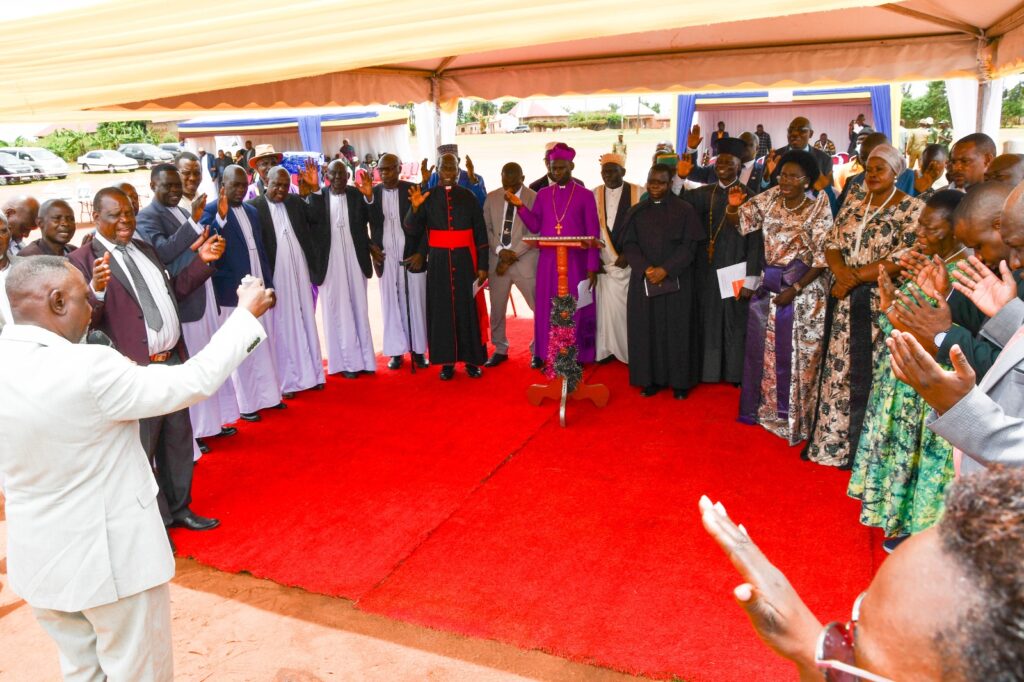
The journey reached its climax on Sunday, 27 September, at Mayuge District Headquarters. From the early morning arrival of guests to the interfaith prayers, scripture readings, sermons, intercessions, speeches, anthems and closing moments, the gathering brought together a wide cross-section of Busoga. More than 2000 people were estimated to have participated in the final gathering, reflecting the scale of community interest and mobilisation around the Prayer Week.
At the heart of the final service was the recognition that transformation begins with a people willing to work together. Religious leaders prayed for the economy and wealth creation, the land of Busoga, unity, the Kingdom, children and youth, political and religious leadership, the work of the Busoga Consortium for Development and Uganda as a nation. The prayers moved beyond individual concerns and placed the future of the region before God.
The message of building also appeared in the voices of leaders. The gathering created space for political, religious, cultural and development leaders to speak about the responsibilities that accompany leadership. The presence of different categories of leaders illustrated that Busoga’s challenges cannot be solved by one institution or one sector. Government, local governments, faith institutions, cultural institutions, civil society, communities and individuals each have a role.
One of the most powerful lessons of the week was that prayer cannot become an excuse for inaction. The biblical story that inspired the theme is a story of prayer followed by inspection, organisation, courage and work. In the same way, the Prayer Week invited Busoga not only to ask for God’s intervention but also to examine its own responsibility. If households are to prosper, people must embrace productive enterprise. If children are to thrive, communities must protect education and their future. If the region is to develop, leaders and citizens must work together and protect the common good.
The Prayer Week also provided a platform for community stories and testimonies. These stories matter because development is not experienced through statistics alone. It is experienced in households, schools, farms, churches, mosques and villages. They remind us that transformation is ultimately about people whose daily lives can become more secure, productive and hopeful.
The participation of the media extended the reach of the programme beyond those physically present. Coverage and live broadcasting helped carry the conversations about Busoga to wider audiences. The Prayer Week therefore became not only a gathering but also a public narrative about a region seeking renewal through faith, unity and collective responsibility.
Yet the greatest test of the Prayer Week will come after the microphones are switched off and the tents are removed. A prayer gathering becomes transformative when its message continues into everyday decisions. The real measure is whether leaders continue the conversations, whether communities act on the lessons, whether institutions cooperate more closely and whether the development priorities raised during the week become practical action.
That is why “Let Us Rise Up and Build” should not end on 27 September. It should become a way of thinking. It should challenge the student to build through education, the farmer to build through productive agriculture, the entrepreneur to build through enterprise, the leader to build through service, the parent to build through responsible families, the faith community to build through unity, and every citizen to ask what contribution they can make.
Busoga does not need spectators to its transformation. It needs builders.
The 2026 Busoga Prayer Week brought thousands together in prayer. Its deeper invitation is to bring millions together in purpose. The wall that must be built is not made of stones alone. It is made of trust, discipline, education, enterprise, responsible leadership, community cooperation, faith and a shared conviction that the future of Busoga is worth building.
Nehemiah’s people did not rebuild because the wall was easy. They rebuilt because they decided that what had been broken did not have to remain broken. That is the spirit with which Busoga must move forward.
Let us rise up. Let us build. And let the work that follows our prayers become the testimony of what we believed.
The Prayer Week has ended, but the work continues. Join the conversation and share: What part are you playing in building a stronger Busoga?